Reviving off-plan sales and new-build housing: the options debated in Luxembourg
A market seeking a new balance
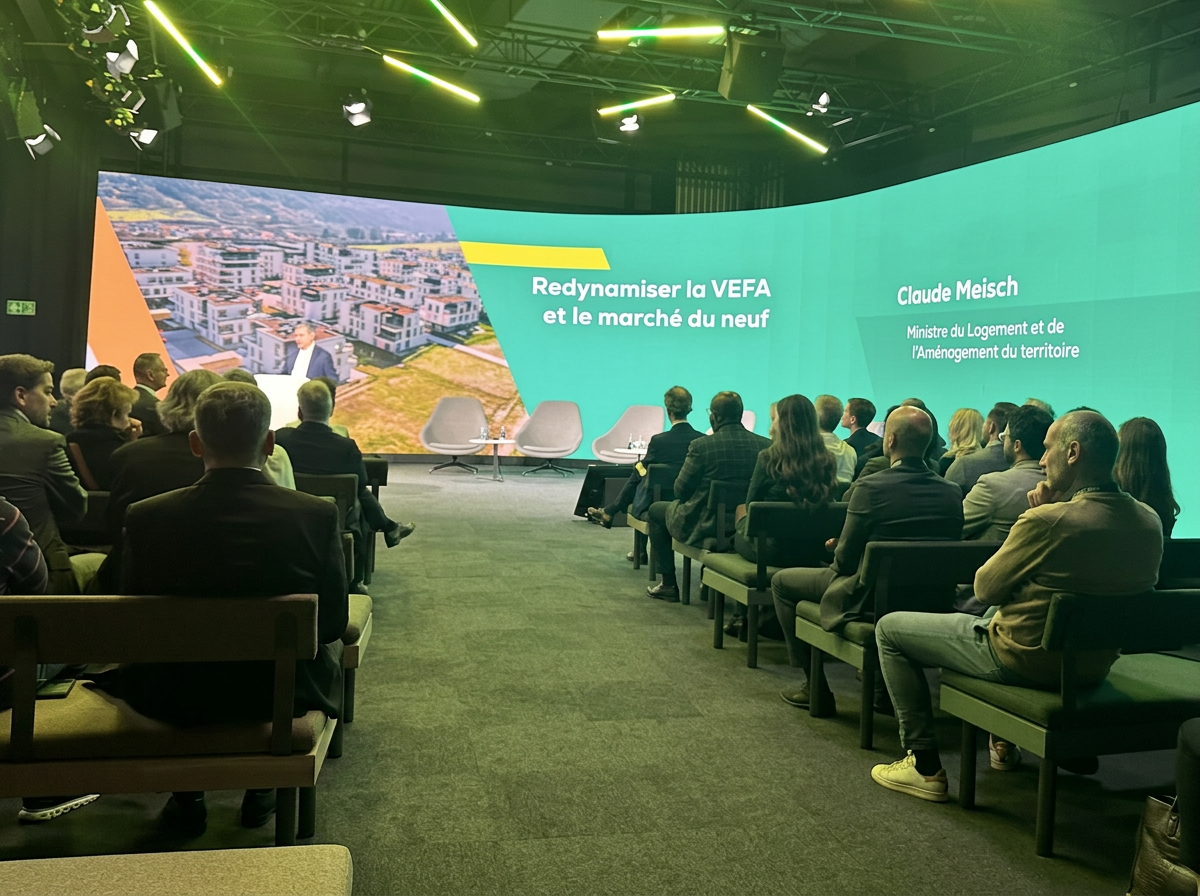
At the conference "Redynamiser la VEFA et le marché du neuf" (reviving off-plan sales and new-build housing), attended by Claude Meisch, Minister for Housing and Spatial Planning, bankers, developers, investors and designers took stock of a market in transition.
Over three to four years the context has changed deeply: purchase prices have eased somewhat, while interest rates have moved from about 1–2% to 3–4%. Speakers remain optimistic in the long run: population and employment keep growing, and many cross-border workers would like to live closer to their jobs.
"6 × 6 × 6" accelerated depreciation
One speaker presented this scheme aimed at buy-to-let investment: six years, 6% depreciation per year, on a construction value capped at €600,000. The cap applies to the construction part, not the total price. Studios and one- or two-bedroom flats would often stay below it. Above it, the standard 2% regime would apply. These conditions should be checked in official texts and with a tax adviser.
Bringing investors back
To attract institutional investors, a net running yield of about 7% was mentioned, with an IRR close to 8% including leverage and potential capital gains. These are views expressed in the debate, not guaranteed returns. Luxembourg must also offer projects of sufficient size.
The State as buyer and partner
The State can support the recovery by buying homes, investing and managing a housing stock, alongside the private sector. A public purchase secures part of a project, reassures banks and buyers and helps reach the pre-sale threshold. The challenge: avoid artificially propping up prices or creating two-tier housing.
Pre-sales, financing and bridging loans
Banks usually require 70–80% pre-sales before securing a project's completion. Yet residences now average around twenty units versus about twelve ten years ago, which lengthens marketing. The 24-month limit on bridging loans then becomes an obstacle. Speakers called for dialogue with the regulator, without dropping prudence.
For buyers, real repayment capacity matters more than the deposit alone: income, expenses and a buffer for the unexpected must be assessed to avoid over-indebtedness.
Really lowering the cost for buyers
Tax simplification and a review of transfer duties, notably for homes less than 80% complete, were mentioned. The principle: lower the final price rather than shifting costs between developer, State and buyer.
Building faster without sacrificing quality
Once started, a site moves quickly; uncertainty lies mainly upstream, in obtaining the building permit. Municipalities, fire safety, the ITM, archaeology, environment: multiple authorisations make start dates hard to predict. Suggested ideas:
- simplify procedures and limit redundant checks;
- better coordinate administrations;
- tailor procedures to project complexity;
- optimise design upstream.
Flexible homes and adaptable buildings
Off-plan layouts do not always match household needs. Architects and engineers are encouraged to design reconfigurable rooms and buildings able to change use, for example from offices to housing, provided this is planned from the outset. Reuse of existing structures and sensible densification complete these ideas.
Key takeaways
Reviving new-build housing appears as a collective effort: the State secures demand, banks adapt risk analysis, developers adjust prices and products, and designers think long term. To follow new-build and off-plan supply in Luxembourg, browse the listings on the Nextimmo portal.
Rates, caps and percentages quoted are those reported by speakers and are neither legal rules nor guaranteed market data.