Modular Housing in Kirchberg and Mersch: A 15% Cost Drop in 2026?
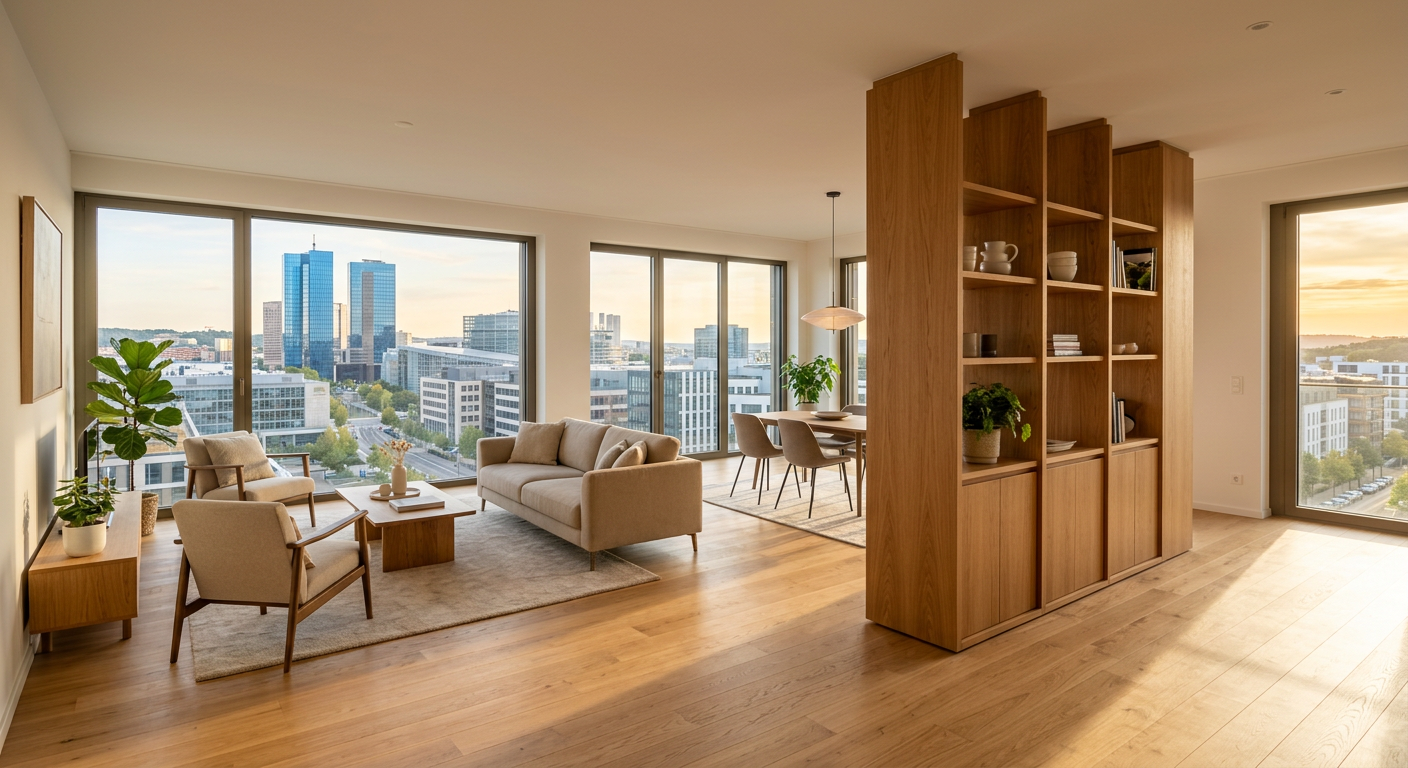
The Luxembourg real estate market is undergoing a major transformation in 2026. Between the new government measures "Booster fir de Wunnengsbau" and the emergence of modular projects in Kirchberg and Mersch, opportunities for buyers are multiplying. Thanks to targeted tax relief and flexible architectural concepts, the effective acquisition cost for new projects can decrease by up to 15% in 2026 [1].
The "Booster fir de Wunnengsbau" Plan: An Unprecedented Financial Lever
Presented by Ministers Claude Meisch and Gilles Roth, the "Booster fir de Wunnengsbau" package aims to sustainably relaunch housing construction while supporting home ownership [1]. The flagship measure for 2026 concerns the exemption from registration and transcription duties on the construction portion of VEFA (off-plan) housing that is at most 80% complete [1].
This exemption, valid for three years starting from July 16, 2026, means that duties will only be due on the land value, significantly reducing the initial bill for primary residences [1]. At the same time, the "Bëllegen Akt" tax credit has been increased to €45,000 per person, strengthening household purchasing power [1].
Kirchberg and Mersch: The Laboratory of Modular Housing
In Kirchberg, the Fonds Kirchberg continues to innovate with the concept of "prix plafonnés" (price caps) and the systematic use of emphytéose (99-year leasehold) to decouple land costs from construction costs [2]. However, the real novelty lies in interior design: projects now integrate non-load-bearing partitions and flexible layouts that allow for space adaptation without altering the architectural shell [2].
In Mersch, a strategic municipality in the center of the country, developers are adopting similar approaches to attract young families. By offering "evolutive" housing where an extra bedroom can be easily created or removed, buyers can purchase an optimized surface area initially, reducing their initial loan while maintaining future potential.
The State as a Catalyst for Construction Sites
To ensure these projects break ground, the Luxembourg State has injected an additional €300 million for the acquisition of VEFA housing [3]. This partial acquisition strategy by public authorities allows developers to reach the pre-sale threshold required by banks more quickly, triggering financing and the start of construction [1][3].
Prime Minister Luc Frieden also introduced the "housing bond," a state-guaranteed bond designed to mobilize private savings and accelerate the construction of affordable housing [3]. In 2026, the Fond du Logement plans to double its annual output to exceed 200 completed apartments [4].
More Favorable Financing Conditions
The banking context in 2026 supports this dynamic with interest rates stabilized around 3% [5]. Personal down payments remain a major decision-making factor, but reinforced state aid facilitates the financing application process [5]. For buyers targeting energy-efficient housing, enhanced interest subsidies are also available to support young families [1].
Sources
- Booster fir de Wunnengsbau - Gouvernement.lu
- Affordable housing in Luxembourg - Ideas Factory
- Logement abordable: le Luxembourg lance un «housing bond» - L'essentiel
- More than 200 affordable apartments in pipeline - Luxembourg Times
- Mortgage in Luxembourg 2026 - Carmo Immo